Wednesday, September 23, 2015

Ready for take off

The innings seemed to have been going well. Although it had been a struggle to get the opposition out, things seemed to have been going well batting wise and the team had seemed poised to get a healthy, match winning, first innings lead.
Suddenly though there was a flurry of wickets. The batsmen in the team played extremely poor shots. It left the captain in shock. He was left stranded. In no time, a possible match winning lead had turned into an almost certain match losing deficit. The advantage seemed to have been squandered by the team. By the end of the first innings, no one gave the team a chance. It was down and out, done and dusted, experts thought. 

Then started the 2nd innings. Under trying conditions, the team had to follow on. The circumstances were tough. The captain tried to weather the storm. He was hit in the body, sledged upon by the opposition. But he carried on. He was extremely resolute on not giving it away. Very importantly, the captain was joined by a very able ally. The ally too looked calm in the face of storm, and under the guidance of the captain seemed willing to fight it out.
Together, the two started to gut it out. They did not lose patience. They showed extreme grit and determination. Their technique was rock solid. They held fort without doing anything rash. The partnership flowered, their confidence grew. They goaded each other, complemented each other. Runs started to come. Some top quality shots were played. Slowly but surely, they chipped  in to the deficit. The opposition shoulders started to drop, the ball grew older. The two then got runs with little discomfort. The corner had been turned, the team was able to build a solid lead. Eventually, they were able to bowl the opposition out and win the game. It was a herculean effort to turn the tide. The critics had been proved wrong, opposition mouths were shut. The team had risen from the ashes, like a phoenix.  

Now that the game is over, the captain feels relieved to have won. He cannot thank his ally enough. He feels extremely fortunate to have a player of that pedigree in his team. With such quality player by his side, he strongly believes their partnership can take the team places.  

Indeed, this win is only the beginning. The team is now only getting ready for take off. As the captain puts it, now only sky is the limit!

Saturday, March 15, 2014

Truth is stranger than fiction

Reality:

Thursday, February 27th 2014. Seattle. I was feeling very tired physically, and stressed out mentally. Life on both professional and personal fronts had been very stressful the past few days and there were no signs of things relenting over the next few days/weeks. Late evening that day, I closed my eyes momentarily. But I was so tired that I fell asleep instantaneously. So instantaneously in fact, that it felt as if I'd been given a bout of anesthesia. 
Like when in a disturbed sleep or when under the effect of anesthesia, it felt as if I was periodically waking up. But did not feel totally conscious in the half asleep mode, and was in a zombie state about what was happening around me.

Then, probably, I had a dream.

Dream:

After having slept tired the previous evening, I woke up totally conscious from my sleep, the next morning .... but guess what, I was no longer in Seattle. In fact I was no longer in the US. I was in India with my parents and family! I glanced at the calendar, it was Saturday the 1st of March. I had somehow skipped one day ... Feb 28th. Was I asleep for more than 24 hours! Surely that can't be true. I pinched myself (as someone had constantly been asking me to :) ), to do a reality check. But heck, this was real .... I was indeed in India, it felt. 

The next one week I was in India. All of a sudden, there was no pressure of work. I was on vacation. Ate great food, watched fun movies, traveled distant places ..... and moreover, met great people! Felt as loved, pampered, cared-for as never before. Life was perfect, a fairy tale, it seriously cannot get better than this I thought. I was having the time of my life. Was turning out to be the best vacation I'd had for a long, long, long time! Way better than even the best of my previous vacations where I would go travelling/sight seeing to different parts of the globe!

But fairy-tales don't last forever. I glanced at the calendar. It was Saturday March the 9th. Overwhelmed by the unexpected happenings of the past one week, I closed my eyes to soak in the moment. And again, I felt asleep. Sometimes you can't get sound sleep when you're too tired. Then there are some other times when you can't sleep in peace because you're just too happy and excited. With me, this time round, it was the later case. I'd fell asleep for sure but it was not a sound sleep. I was periodically getting awake, but again, in a zombie state about what was happening around me.

Then, probably, things got back to reality.

Reality:

My alarm went off. And I woke up totally conscious, but confused. I looked around to figure out where I was and, expectedly, I was not in India. I was at home in Seattle. The dream was over. But it felt like a long night, where a lot of things had happened. I was feeling good and it felt like life was different right now from when I had closed my eyes and gone to sleep the previous evening.

But anyway, I glanced at the clock .... it was 6 in the morning. Was time to get ready and go to work and brace for a hectic day/week/month ahead. Was time to get back to the real world!

Things seemed to be normal after that, I was out of the hangover of the last night and was kind of over the dream and not thinking too much about it. But then, just as I was sipping my morning coffee, my eyes went to the calendar. And I was shell shocked. The calendar showed Monday, March 10! What the heck, I thought, and I pinched myself .... again ... and again .... and again .... and again ..... but yes, it was Monday, March the 10th 2014 after I'd momentarily closed my eyes and fell asleep on Thursday February the 27th 2014!

It was then that I finally came to grips with, and accepted, the situation. The week from March 1 to March 8 in India was not an illusion! Yes, it was fairy-tale-ish. Yes, it was dream like. But it was not a dream. It was a reality. That week had indeed happened in my life! And it was unbelievably unbelievable. It was fantastically fantastic. It was a week that I would never forget in life.

I was amazed at how ridiculously easy it has become to move from one corner of the world to another, and back, in such short time. I then re-thought and re-lived the happenings of the past week for a few moments, laughed at my own disbelief, finished my coffee and started driving to work.  As I was about to reach office, my phone rang. And it gave me yet another reality check that life was indeed starting on a new page now :) .... truth is indeed stranger than fiction, I wondered.

Monday, February 24, 2014

Zinda hoon yaar kaafi hai ....

Mere haathon hua jo kissa shuru, usse poora to karna hai mujhe ....
Kabra par mere, sar utha ke khadi ho zindagi .... aise marna hai mujhe ....
Kuchh maangna baaki nahi, jitna mila kaafi hai ....
Zinda hoon yaar kaafi hai ....

http://www.youtube.com/watch?v=OWtDLQY_p4Y

Friday, November 15, 2013

Just like him

I usually do not find much motivation to express thoughts about Sachin Tendulkar. So much is written, spoken, and analyzed about him, I bet there wouldn't be anything new to add. Another few hundred words from me would just add to the garbage I feel. I anyway hate to go with the masses; it irritates me no end when I hear/read people addressing him as "God". Not because I don't like Tendulkar, it's because people's mentality of idol worship for an individual freaks me out no end. And I pride myself on staying away from such craze. 

In the last few days however, the media and social network frenzy about Tendulkar has been something that you can't shun yourself off. It urged me today to make a youtube trip and watch some of his innings, mostly from the 90's. Being a die hard fan that I used to be, I remembered all of those innings. And the nostalgia of reliving some of those memories makes me express my thoughts about him. "My 2 cents" as they say.

I have a lot to complain about Tendulkar the cricketer. People called him the best batsman of our times but I would always argue against that, mostly based off his performances in test cricket.
He would pull down the shutters and get very defensive when the end of a test match session, or end of day's play, was nearing. He would also get overly defensive when nearing milestones, like during several of his centuries. This attitude of his, hurt the team. It hurt Tendulkar himself, he would lose his rhythm and get out.
At times, he would seem to overly complicate simple things against a slew of slow medium pace bowlers and ordinary spinners. He would seem to give undue respect to too many bowlers and score very slowly. One would feel frustrated about how he could face an Allan Donald with such ease and then struggle against a Hansie Cronje.
One always got the feeling that he was more than capable as a leg spin bowler. Why then could he not contribute more with the ball? Had he done more of that for the team, the team would have got a genuine all rounder and that would have helped the team immensely.

I therefore asked myself why, why is it that this guy still occupied a special place in my life! Why do I feel sad today when he is retiring?

After some thought I got my answer: In some way, at a lesser magnitude of course, I thought of myself as similar to him - I find it tough to get work done in office on Friday's or even late in the evenings. Lot of time during this time inevitably gets spent on Facebook and I invariably end up "playing for stumps", just like he pulls down the shutter when end of day is approaching. In my school days I didn't do well in quite a few exams in spite of preparing well just because the pressure got to me and I got too anxious, just like he seems to get nervous when approaching milestones. My team expects me to work on stretch goals to add more value to the team and it is tough to keep up with those expectations, just like he found it tough to contribute consistently to the team as a bowler in spite of having the talent. And my habit of over analyzing and over complicating simple things, just like his, have been a major problem in life throughout!

Long story short, I liked him not because he was "God", but because he was human. Unknowingly, I had modeled my game (read tried to model my life) just like his!

He would put his heart and soul into his work. He would work tremendously hard to get better at his skill. On a given day, he may or may not have succeeded (he succeeded more often than not), but he would give it everything, you could not doubt his effort. He would hate to lose but would never go the wrong path to win. 

May sound bombastic here, but I tried to base my own life on these very traits/principles ...... just like him. If these principles were to ever have a face, then I feel it would be Sachin Tendulkar's; for he epitomized these very traits ever since I began to understand somewhat little about this thing called life.

Then there were some of his other traits - He was a typical marathi middle class boy who earned the riches but yet never compromised on his principles, never forgot his roots, and remained ever grateful to all the people who helped him along the way. He was a foodie, loved good clothes, but deep inside he was still the same middle class boy. He was always aggressive but never brash. He was shy and awkward in public but a complete brat when with family/friends. He loved playing cheeky shots, he broke a lot of windows in his colony during "half-pitch" cricket (seriously, would kids in India today ever get to play "galli" cricket and break windows! Does a Xbox Kinect provide the same thrill!). Again, can't help but relate to some of these traits of his.

Tendulkar's next big contribution was that he spread joy in the lives of people at times when there wasn't much to look forward to. He made his debut long before there were any shopping malls, multiplexes, and international standard restaurants and coffee shops in the country. Entertainment options for the masses were few and far during those times but Tendulkar was the savior. Yes, he may have batted slow in tests  approaching milestones, he may not have been able to win as many matches on his own for India as one would have liked. But the joy he gave to everyone in the 1990s with his magical batting, the smiles he put on everyone's face, the way he brought the whole nation together when times in general were tough in India, is all unbelievable and undescribable. Dravid/Ganguly/Laxman/Sehwag's time started well after India had already started to announce itself on the global circuit. Tendulkar though was the face, the commonality, between India's transition from an almost under developed country to a fast developing nation.

Overall, I realize today that I may never be able to convince myself one way or the other whether Tendulkar was the greatest batsman of my generation. But one thing is certain. Unknowingly he has been one of the most impactful individuals in my life, and perhaps in the life of countless others in India. He has not only entertained us and given us joy, but has epitomized for us the ideologies which have formed the basis of our lives. Such has been his contribution; not just limited to cricket but he has been a super hero of a billion people nation, like no one else ever has.

Suddenly now, Gavaskar's tribute to Tendulkar yesterday doesn't sound as silly to me: Sachin Ramesh Tendulkar - Thank you, thank you, thank you!

Sunday, October 13, 2013

Mt. Hood - The first step

In the first week of May, I committed to climbing Mt. Rainier this summer. Next, it was time to get down to business: Training for the big climb. I was doing reasonably well as far as the weekend training hikes were concerned. But no technical climbs had been attempted, or even thought of, by Mid May. 

That is when I started to think seriously about Mt. Hood. Like Rainier, but to a slightly lesser extent, climbing Mt. Hood had always been on my To Do list. At 11,249 ft. it is the tallest mountain in Oregon. Therefore, climbing Hood in itself was an interesting prospect and summiting it would be no mean feat I thought. Plus it was a technical climb, the experience of which would serve me well for Rainier. And needless to say, there was the incentive to gauge where I was with respect to my Rainier preparation.

The plan was finalized, a 2 day climb with Timberline Mountain Guides was booked for the weekend of May 18-19. On May 17, having the luxury of a day off from work that day, I walked into REI in the morning to buy all the gear that was missing from my kit. Which included the kit itself, shoes, woolen socks, crampons, base layers, fleece, puffy jacket, rain jacket, rain pants, gloves, mittens .... and the list goes on. About 6 hours after getting in, I walked out of REI with all the gear that was needed, feeling very light on my wallet (Another factor that makes mountain climbing a challenge. It requires a lot of time and money). That said, I was "all set" for the climb, and felt well prepared.

About the actual climb: The good thing was that I was able to summit :), return down safely, and the views we got during the climb were simply breathtaking. 

Some of the pictures from the climb are here

The not so good thing was that the climb turned out to be *extremely* tough, and in a way, it was demoralizing. It was much much tougher than I had originally anticipated: Although known to be treacherous, the climb itself was less than 4000 ft., and did not require any snow camping. Statistically, I had originally thought, I should be able to do it without much discomfort given that I was already training on weekends. But I was wrong. There were a number of factors that I hadn't even thought of, which came to the forefront:

1. Hiking in the night is a completely different ball game 
Alpine starts involve starting the climb by midnight, or very early in the morning. As much as one tries to get a few hours of sleep before the start, it usually doesn't work out for beginners because of the nervousness/anxiety/adrenaline. Besides, alpine start causes body clock to go haywire. Its the same feeling as feeling jet lagged. Climbing a mountain in that state, in extreme cold weather, with rain, snow, and wind is far from an enticing prospect (We'd started the climb at 1 am, I had an almost sleepless night before that, the temperature was 18 F when we started, with 20 mph winds, and freezing rain and snow).

2. Trivial things such as drinking water, using rest room, become problematic
Water bottles have to be typically kept wrapped up in a puffy jacket inside the back pack, so as to prevent the water from freezing. Because of the cold, it is a big overhead to remove gloves, open back pack, get the water out and drink. One typically hesitates to do that. And drinking less water means quicker dehydration and tiring faster. In general, no matter how good a back pack one has, it is very inconvenient to open the back pack (I had to open it at least 10 times during the whole climb) for water, snack, putting on additional gear etc.
About restrooms, firstly the mountain has no restrooms. Peeing becomes extremely inconvenient because as if the lack of dexterity caused by cold and wearing of gloves is not enough, there are the 3 layers of pants and a harness to take care of if one has to pee (Cold weather means frequent urination, and trying to fight the urge to urinate made things even harder for me :)).

3. Have to know very well how to use your gear
Buying all the right gear is one thing. But knowing how to use it is completely another. Learning how to wear a harness, or a helmet, and crampons, in the cold confines of the mountain is extremely challenging (I struggled to use my brand new gear from REI. I should have bought it much earlier and should have used it once or twice before using it on the climb).

4. You can't take your own sweet time to summit the mountain
In most of my hikes, I walk at my own pace without bothering how slow or fast my peers are going. Climbing on the mountain is different. You have to be precisely as fast as the others on your rope team (In my rope team, I was the slowest member and had a hard time keeping up pace with others on the team, tiring me out immensely).

5. Getting down is as difficult as, if not more difficult than, getting up
On the way up, one usually tends to go slow which inherently results in more caution. When coming down, in general, one tends to go faster because of which chances of slipping are quite high. Getting down therefore needs more control and more patience at a time when you're totally out of patience (After summiting, I was too tired and in a hurry to get down. In the haste, I slipped quite a few times (dangerously once), but was fortunate to escape unscathed).

6. Not using sunscreen when in snow is unforgivable
Throughout our climb, the weather was wet and cold with dense fog. So there wasn't any sun protection required, right? Mistake. Big mistake. I got badly sun burnt throughout the climb. That was a rude shock. My face was barely recognizable in the mirror that evening.

Thus went the climb. There were these lessons learnt but I remember thinking, as I was descending down, that there was no way I was going to be able to summit Rainier which was at least twice as difficult as Hood. Moreover, I thought I did not enjoy this technical mountain climbing experience. It was too strenuous. I kept asking myself why was I doing all this. Why was I wasting my energy, time, and money putting myself through all this, when I could have been sleeping comfortably in my bed over the weekend. 

I had to seek answers to these questions and clear my self doubts if I had to harbor any hopes to summit Rainier. That was going to be the goal, and a P1 for me, in the next few weeks.

Saturday, September 7, 2013

To climb or not to climb

Over the last 3-4 years, we'd hiked a lot around Mt. Rainier. We were awe struck by the magnificence of the mountain, madly in love with it. To us, the mountain was god .... and its pinnacle the holy grail. To me, the hike to Mt. Rainier summit was a pilgrimage that every Seattelite must undertake atleast once in his/her life.
 
Earlier this year, an opportunity knocked. Asha, a non profit organization, were providing a guided climb for interested folks in July. The hike to the summit is not easy though. As a matter of fact, its not a hike at all. Its a climb: Hike is non-technical, just normal walking on slightly steeper topographies, with no special gear requirement. Climbing is technical, requires special gear, and special training to learn how to use the gear. Mt. Rainier climb requires gaining considerable fitness, which in turn requires a 6-month training regime. Team Asha guides required a firm Yes/No confirmation about commitment to climb with them this year, by the first week of May 
 
It was the 4th of May, I remember, and I was still pondering whether or not to commit to the climb. During our CrossRoads lunch hour, I tried to persuade my hiking enthusiastic friends into committing to the climb. If they were in for the plan, the decision would have been a no brainer: I would have had to do it then because they were doing it, peer pressure you see :). But turned out, that for various reasons, they did not want to commit to the climb this year.
 
So then, the ball was in my court and I had to again put on my decision making hat. I began to ponder: Given that my friends were not doing it, should I back out as well? Or should I do it alone? Do I have it in me to train day in day out every weekend for the next 3 months? Do I have the time, is there enough motivation?
Mind you though, I was already half way there. Since February, I had been hiking on weekends to gain fitness, so why was it going to be very different doing the same thing between May to July? One difference was commitment pressure: Hiking without commitment is similar to dating a girl or having a live in relationship, hiking with commitment is like marriage :). Second difference was the circumstances. I thought things had changed a bit between January and May.
 
Coming to the point though, I was still confused, not sure about what I should do. I thought long and hard, and eventually came to a conclusion. Firstly, I'd always thought that I was mentally strong enough to survive any situation, mentally I wouldn't break easily. Now if I could also gain the toughness to brave any physical challenges, then I thought that the combination would help me survive anything/anywhere. Secondly, I'd always wanted to let go of this thing called peer pressure. I thought now it was even more imperative for me to not base decisions on others, one should learn to survive and thrive on his/her own if need be. And then finally, I always desperately wanted to summit Mt. Rainier some day. Then why not this year! I had already done the hard work of gaining fitness the past 3 months, and had the time (and fortunately the money) to practice more now. It was just a question of having the discipline to follow a strict regime for the next 3 months, which was also anyway a need of the hour for me.
 
The decision was made. The commitment forms were submitted.

On one hand, I was confident that the decision was the right one because it was made rationally, with sound intent, and keeping the right principles in mind. But admittedly, from the core of my heart, I was still feeling apprehensive and scared of doing this alone. But then again, brain was the boss here. For a change, I kept my heart at bay and let my brain do the thinking. Something that I should have learnt to do years back.
 

Monday, September 2, 2013

The most difficult hike of my life

I've always been a summer hiker. With sun on my back, I seldom thought hiking to be a challenge. In fact, to me, hiking always seemed to be a pleasure.

This year though has been different. I haven't had the luxury of "summer" like conditions. I've had to hike in cold, grey, winter like conditions with "storms" threatening to ruin my "hike". One such hike, and the most difficult one, was the one to Mailbox Peak on the 7th of April this year. 

The Mailbox peak hike is arguably the toughest hike in the Seattle I-90 corridor. It is tiring and taxing in even the most perfect conditions. In my case, what awaited that day was a "storm". Needless to say, the hike was going to be challenging.

Given the poor weather, I had to make a "decision": Should I brave the storm? Or shoud I abandon the hike? I decided to carry on with my hike, and to not let the storm disrupt my plans. The decision was made keeping the longer term in mind. Yes, it would be tough and challenging in the short term tomorrow, but it is the right thing to do considering the more important climbs in the longer term future, I thought to myself.

I had an almost sleepless night, on the 6th of April. But nevertheless, I made sure that I was not late for the hike. At the trail head, the worst fears were realized: It was already pouring down heavily and the forecast wasn't looking promising. Thus, in less than ideal weather conditions, I started the hike. In no time, I was all drenched in the freezing rain. As I climbed altitude, the rain turned into snow, the muddy ground turned into a snow field. I started to feel extremely cold, I was shivering as I was walking along. To make matters worse, my fingers and toes started to get numb. At the beginning of the hike there were quite a few people who had started the hike together, but as the hike had progressed, everyone had kind of got dispersed. Thus, I was walking alone in that condition in the snow storm. Given my idle mind, and that my hands and feet were numb with almost no sensation, I felt like it was a bout of hypothermia. Exaggeration in hind sight, but seemed very probable to me at that time. By this time, I was probably a little more than half way up to the summit. It was again decision time for me: Should I continue to the summit or should I retreat back. I was cold and tired but not enough to give up just yet. I decided to continue. I summoned all the reserves of energy I had left in my body and started to climb quickly. I wanted to get to the top as fast as possible, and rush back down to asses possible damage to my numb hands and feet.

As I marched along, I started to assess my situation in this hike. I started to think what is making this hike so unpleasant and miserable. I thought maybe the conditions were just not suited to hiking. But then there were other folks, that same day and same time, who were climbing along without too much discomfort. I then thought maybe I was just not fit enough. But then again, just the week before, I had hiked with the same group of people and at that time I seemed to have been one of fittest of the lot. So what changed between now and then, I wondered. And I got back the answer. It was my "gear". The gear that I had was not meant for harsh weather. It didn't keep me dry, it didn't keep me warm, it didn't protect me when I needed it. I'd hiked with this gear before without any discomfort. But that was all in sunny weather. Today, when the weather had taken a turn for the worse, the gear had let me down. I kept cursing my gear as I climbed. But then I realized that it was my fault really. I had chosen the wrong gear for the wrong hike. My friends and guides had warned me about the gear at the time I went with it, but I'd ignored the warnings. I was paying for my own sins I thought.

Time passed, and after a grueling four hours or so I somehow managed to get to the summit. As a mark of reaching the summit, I opened the mail box there (hence the name Mailbox Peak btw). It felt like I had to "let go", drop something, leave something in that mail box. And I surely did: I left my inhibitions, my negative energy, my frustrations with the gear all there. The climb down turned out to be easier. More importantly, I reached back the trail head with no damage done to my hands and feet. Sensation returned as altitude decreased. I was relieved that I was safe, and happy that I did not abandon the hike in some of the toughest conditions I had ever encountered.

I returned home, had a shower, and then decided once and for all to let go of the gear and its thoughts. Next to follow that evening was a well deserved, filling dinner at IHop. At the dinner, I told my friends this story of my gear and the decision to part ways with it.

The previous night had been a sleepless one, but this night, after the eventful day, I managed to sleep well. It was an unforgettable hike.

Monday, June 6, 2011

Getting a wicket

Finally, there comes a breakthrough, a wicket that a team so desperately needed. But the captain wonders, has the wicket come a little too late. Has the game already been lost ? Or is there still a time for comeback ? More often than not, there are no miracles in this game. And the moment you feel that a wicket has come a little too late, that is the correct feeling. Yes, more often than not, the game has already been lost! We live in an era plagued by match fixing. And this particular game was lost because of bowlers deliberately spoiling the party.

So much goes through a captains mind, both on and off the field. This match is gone. But what about the future games? Should the captain, aware of the players' wrong doing, act as the whistle blower? Or should he show a little more patience, give the players another chance and observe them for a few more games? Besides, a good captain just cannot speak his mind out. He has to keep things to himself. He has to pretend to be calm, even if he's not. He cannot vent out his angers and frustration. For whatever he says may potentially impact his whole side. It might destroy his team, it might ruin his career. He cannot just come up with allegations, every allegation requires concrete evidence. Even if he does come up with evidence, a game that has been lost cannot be won back again. Glory that has been lost cannot be restored back in a day.

Rebuilding a side plagued with wrong doing allegations takes years to do. It isn't an easy decision to bring to justice the players involved, particularly if the players have a lot of promise. However, one just gets the feeling that that's the right thing to do. The foul fruits have to be weeded out, the rotten mangoes can otherwise spoil the rest as well.

Success, however, is not just about doing the right things. Success is about doing the right things at the right time. The captain needs to wait, not just for this game, but for this series to get done. The best he can do for now is hope that his chaps had only been involved in this game, and would help pull the side through in the next game. Once done with the series, time will be just right to settle scores ..... by taking the bull by its horns.

Tuesday, March 1, 2011

A not so random quote ....

.... "You have a lot to learn, but fight is not one of them" ....

Saturday, February 12, 2011

Death Valley National Park - The winter haven

Thanksgiving weekend is one of the longest long weekends that we get in the year; 4 days is a long enough time to make a good trip to almost any corner of the country. Unfortunately though during thanksgiving weekend, weather plays the spoil sport. Almost every touristic place gets too cold, leaving very few options to choose within the country.
Death Valley though is one place that is just perfect to visit during thanksgiving. And its proximity to Vegas means that one can get a good mix of the peace at Death Valley with the lively and frenetic night life of the Sin city.

So what exactly is death valley? It is the hottest and driest of the national parks in the United States. Its home to the second-lowest elevation point in the Western Hemisphere. The natural environment of the area has been shaped largely by its geology. Its diverse geologic features, desert wildlife, historic sites, scenery, and clear night skies are some of the reasons, why the place is visited annually by more than 770,000 visitors *.

My planning for the trip started about 2 months before thanksgiving with booking of the bare necessities (read flight). The plan was to spend 2 of the 4 days in Death valley, 1 day in Zion national park, and get 2 nights and a day in Vegas. I always end up trying to cover as many places in one go as I can, the optimization ends up in hectic trips a lot of times. But heck I just love it that way :).

So then accordingly, three of us guys flew to Vegas Thursday morning (thanksgiving day). We were in Vegas as early as 8:30 in the morning, but spent time renting car, shopping and waiting for two females in the group to join us, who were flying in from a different city. Post a late heavy breakfast, the five of us finally started our drive towards DV at about 11. The 3 hour drive from Vegas to DV visitor center at Furnace creek took us 4 hours: On the way, about half an hour before Furnace creek was our lodge (Amargosa Opera House) where we stopped, checked in, had lunch and then proceeded towards DV. The hotel was not the greatest, but there is a real dearth of lodging places near DV area. And because I'd got lazy in looking up for bookings near Furnace creek lodge, it just got too late for us and there was no other option to choose.

Anyway, we also got a lunch (with limited options) at Amargosa, and finally reached DV visitor center at about 3. We did not need too much of information at the visitor center, I had already done a detailed study of the places that just cannot be missed when at Death valley. These places were: 1. Sand Dunes at Mesquite, 2. Zabriskie point, 3. Dantes View, 4. Devils golf course, 5. Badwater basin, 6. Gold Canyon, 7. Ubeheb Crater. Ofcourse, just knowing the places to visit is not enough. It is also important to know the best time to visit the place. Based on this study, the plan was to be at the Mesquite Sand Dunes for sunset, and visit places nr. 2 to 7 the next day i.e. Friday.

The Mesquite Sand Dunes are at the northern end of the valley floor and are nearly surrounded by mountains on all sides. Due to their easy access from the road and the overall proximity of Death Valley to Hollywood, these dunes have been used to film sand dune scenes for several movies including films in the Star Wars series*. DV temperatures during thanksgiving are at about 75 F and the feel of hot sand beneath your feet, particularly when coming from sub zero temperatures is just heavenly. Besides, the sand dunes are a gorgeous sight. I have not seen the sand dunes at Florence Oregon, but the sand dunes here were the best I've seen in this country. The dunes should be particularly visited during sunset, or I should say half an hour before sunset. Sun sets in the opposite direction of the dunes, and the light on the sand gives it a magnificent glow. Perfect time for pictures.

As I'd said, we were at Furnace creek visitor center at 3. The Mesquite Sand Dunes are about half an hour north west of the visitor center and sunest on that Thanksgiving Thursday was supposed to be at 4:20. Based on this calculation, it should have been an easy coast for us. But it was not. For 2 reasons: There are a lot of good places to stop by right along the road to the dunes. Too tempting to not stop for taking pictures. Therefore instead of 30 minutes, it took us about 50 minutes to get to the sand dunes. Number two, even though sunset was supposed to be at 4:20, we discovered that the dunes were already under shadows by about 4:15. The crux is, I realized, to reach the dunes atleast half an hour before sunset. That's the best time to see the dunes and get the best pictures. We'd missed the best time to be here, on that Thursday. But decided we'd be back here the next day, well before sunset, at about 3:45 pm. That's another huge disadvantage of trips in winters: Days are so short, you have to be extremely meticulous in your planning .... and the resulting execution gets hurried sometimes. But anyway, not all was lost for us that Thursday evening. We had a ball of a time playing in the sand :) , and capturing some decent silhouettes.


On the way back to our lodge, we stopped at the Furnace creek visitor center. There are a couple of restaurants, a grocery store, and a gas station here. Must say, the restaurants are very impressive. We'd started from Seattle at 4:00 in the morning, it had been a tiring day. Having an early dinner beside the visitor center restaurant was thoroughly soothing and enjoying (ofcourse, given the limited number of restaurants, it takes quite a long time to get seated, to order and finally for your order to get to your table). After the filling dinner, we started back the drive to our lodge and were cosing in bed by about 8:30 pm. The next day (Friday) was going to start really early for us (5:30 am) and it was therefore important to get enough of good sleep.

Zabriskie Point is an absolute must see place in death valley. It is part of Amargosa Range located in east of Death Valley in Death Valley, noted for its erosional landscape. The location is featured prominently on the cover of U2's album The Joshua Tree. This location was also used to represent the surface of Mars in the film Robinson Crusoe on Mars*. The landscape you get to see here, along with the colours, is simply unbelievable. Sun rises in the direction, opposite to Zabriskies point and therefore the best time to visit this place is sunrise, or should I say half an hour post sunrise :). Sunrise was supposed to be at 6:15 am that Friday morning and Zabriskie point (about 2 miles east of the Furnace creek visitor center) was about a 30 minute drive from our lodge. After the experience of the last evening, we folks had got a good lesson that the sun does not wait for us to set or to rise. We were up at 4:30, checked out and left the lodge at sharp 5:30 to reach Zabriskie at 6. We quickly parked and got into position with our cameras to capture THE moment. We then experienced something that we'd not expected: Cold. And wind. It was supposed to be a beautiful day at DV with a max temperature of 80 F. However, in early November early-mornings, the temperature is close to 35 F and with the wind chill, our hands were badly frozen. Do not forget to take a good pair of hand gloves when going for a sunrise here. Anyway, we fought with the cold and the resulting running nose, to see the effect of sunrise. And boy it was plain stunning. The sight of the first rays on the mountain range and the resulting colors is something that I'll never be able to describe. My hands were too cold to take a good picture, and the effect of cold was so severe that we left the place in a hurry at about 6:30, just 15 minutes after sun rise.


In hind sight, we should have waited there for some more time. Till about 7 am. If you see my pictures, the lower half of the pic is still under shadows. It would have been stunning had the complete landscape been enlighted, which is why I would suggest to wait for atleast half an hour post sunrise. And its a sin to forget your hand gloves and good warm clothing!

From Zabraskie we rushed to the visitor center restaurant for breakfast and after yet another satisfying experience there, we were all set to explore Death valley that whole day. Place number 3 to visit was Dantes view: Yet another stunning location for its view. From Dante's View one can see the central part of Death Valley from a vantage point 5,500 feet (1,700 m) above sea level. From here Badwater Basin can be seen, which contains the lowest dry point in North America. Telescope Peak can also be seen from here which is 11,331 feet (3455 m) above sea level*. The drive from visitor center to Dante's view was about half an hour. There are a few short trails that stem from the parking lot to points which offer good photo opportunities. We headed along one such trail, took a few pictures, and were ready to leave in about half an hour. It was already about 9:30 then, as I said we had to hurry through sometimes because of the sheer number of places to visit and the limited number of hours on hand.


From Dante's we started driving towards the low lying areas of Death valley, namely Badwater Basin and Devils golf course. They're a good one hour drive from Dantes view: You have to drive almost back towards visitor center and then head 15 miles south. As you start heading south, there goes a small (about 8-mile) driving loop which is a scenic drive from where the artists paletter can be seen. We went on to explore this (in hindsight, we might as well have skipped this) and then headed to the devil's golf course which is on the way to Badwater basin.basin. The Devil's Golf Course is a large salt pan on the floor of Death Valley. It was named after a line in the 1934 National Park Service guide book to Death Valley National Monument, which stated that " Only the devil could play golf " on its surface, due to a rough texture from the large Halite salt crystal formations*. Let alone playing golf, the surface here is such that it is extremely difficult to walk over the surface. After taking a few pictures of the surface, we headed to Badwater Basin.


Badwater Basin is the least elevation point in North America, it sits 282 feet below sea
level. Unlike at the Devils Golf Course, significant rainstorms flood Badwater, covering the salt pan with a thin sheet of standing water. Each newly-formed lake doesn't last long though, because the 1.9 inch (48 mm) average rainfall is overwhelmed by a 150-inch (3800 mm) annual evaporation rate. While flooded, some of the salt is dissolved, then is redeposited as clean, sparkling crystals when the water evaporates. Also can be seen in the Badwaters basin surface are hexagonal saucers that are approximately 2 - 2.5 metres in diameter. These are part of larger-scale features that are also hexagonally-shaped and can be seen from Dante's View nearly 6000 feet (1800 m) above. The saucers are formed after the salty pan begins to dry and the salt crystals expand*.


The almost hour and a half drive from Dantes view to Badwater basin and spending almost 90 minutes, together at Devils golf course and Badwaters, meant that it was already 12:30 pm by the time we started to drive back from Badwaters. We had to re-assess our plans at this point. We were very sure that we wanted to be at the Sand Dunes at 3:45. The drive from Badwaters (south east end of the park) to Ubehebe crater (which is at the Nortwest end of the part) takes about 90 minutes I knew. And the drive from Ubehebe to Mesquite dunes takes another 45 minutes. Additionally, on a hot (and therefore a bit of tiring) day we also had our stomachs to fill. We therefore realized that, realistically, we would have to skip one of Gold Canyon and Ubehebe Crater if we wanted to see the sand dunes before sunset. And Gold Canyon it was that we decided to skip. The reason to skip Golden Canyon was that we were to go to Zion National Park the next day and everybody thought that the landscapes and colors we would get along the 1-mile Golden Canyon hike would be very similar to what we would get in ZNP.

So then, we started the 90 minute drive from Badwater Basin to Ubehebe crater. On the way, stopped at the visitor center for the third time to pick up a quick lunch .... and off we were to Ubehebe Crater, where we reached at about 2:30. Ubehebe Crater is a large volcanic crater of the Ubehebe Craters volcanic field in the northern half of Death Valley. The crater was formed when magma migrated close to the surface and the heat of the magma flashed groundwater into steam, throwing large quantities of pulverized old rock and new magma across the stony alluvial fan draped across the valley floor. The magma rose through a fault that lies along the western base of Tin Mountain. Movement on this fault was responsible for uplift of the entire Cottonwood Mountains range*. Honestly, we only got a glimpse of the crater and we were at its rim for only about 15 minutes. We were forced to immediately start our drive back to Mesquite.


By the way, the drive to the "Racetrack" starts from near Ubehebe crater. The Racetrack, is a scenic dry lake feature with "sailing stones" that leave linear "racetrack" imprints. The sailing stones are a geological phenomenon found in the Racetrack. The stones slowly move across the surface of the playa, leaving a track as they go, without human or animal intervention. They have never been seen or filmed in motion*. To me, the Racetrack and the rolling stones is the most prominent feature of Death valley. Unfortunately though, access to this area is not very convenient. Its about a 30 mile drive from Ubehebe crater along an unpaved, stony road therefore requiring only heavy duty vehicles with strong traction tyres.

So then, at about 2:45, we started the drive to the sand dunes, and this time there was no mistake. We got there at 3:15 , well before sunset and the one hour there till sunset was fabulous. Was completely worth coming back here the second time, after the miss the previous day.


As the sun set, it ended an exciting day for us in Death Valley. It was a day we well and truly utilized very well. I was a little disappointed that we could not do the Golden Canyon hike. In retrospect, we should have somehow saved an extra hour on Thursday. That would have enabled us to not come back to the dunes on Friday. Also, I realized later that Ubehebe crater is best viewed when the sun is overhead .... not on the horizon. Thus, from Dantes view, we should have headed to Ubehebe first, then done the lower elevation spots just before and during sunset (assuming we would have completed Mesuite Sand dunes the previous day itself). Overall, it was a memorable trip at DV ..... maybe if I get another chance to visit here sometime, I'll correct the small mistakes that were made in this trip.

From Death Valley, we drove straight for more than 4 hours to our lodge near Zion National Park (ZNP). For us, the next day was going to be another one to look forward to at ZNP. I would not however describe the details of ZNP here ...... those would better be described as part of a full Utah trip some day :) ..... plus honestly, it gets a little too tiring to spend 2 days in DV, then spend the 3rd day in Zion, then drive back to Vegas the 3rd night and spend that night in the casino's.

For a less tiring and a little less adventurous 4-day trip, the next 2 days post DV can be spent in Vegas. Day time on Saturday and Sunday can be spent relaxing in Vegas hotels, nocturnal activities in the Sin City need no mention ;). If you want to stay in Vegas 2 full days, yet utilize the day time, places close to Vegas such as Hoover dam can also be visited.

Some of our ZNP and Hoover dam trip pics:

ZNP Entrance
Zion Canyon
Zion Canyon from Canyon overlook trail
Zion-Mt Carmel highway
Hoover Dam

(* Ref - Wikipedia)

Monday, January 3, 2011

Oregon - Infinity Loop, Painted Hills, Crater Lake

Oregon is one of the most diverse states as far as variety of landscapes is concerned. Within an area of 400 sq. miles, one can find snow clad mountains, dense forests, vast deserts, beautiful beaches, sand dunes, lakes, fossil hills .... you name a landscape and you'll find it here. Its a state that is in true Pacific northwest spirits. If you're looking for options to spend a long weekend or so in summer, I would strongly recommend a trip to Oregon to experience the splendid north cascades.

When visiting Oregon, there are some places that *MUST BE* visited and just cannot be missed. These places are the Infinity Loop (Columbia River Gorge, Multnomah falls, Mount Hood), Painted hills, and Crater Lake. Then there are some other places that are also very beautiful but you *may* find similar or better spots than those elsewhere. Such spots include Canon beach, Japanese garden in Portland, the sand dunes near Florence etc. Depending on how much time you have, you may want to do some or all of these spots. Typically, even with a reasonably hectic schedule, it would take at least 3 days to do the 3 *MUST DO* spots I mentioned above. If you're willing to plan an extended trip of about 5 days then you may also be able to cover the rest.

Typically, to avoid taking a lot of vacation, I plan trips of mostly 3 days duration. Such trips can typically be done on one of the long weekends in the summer or by taking just 1 day of vacation adjoining a weekend. Because of this personal preference, I describe below a 3-day plan for an Oregon trip that can typically be followed over a summer weekend. Infinity Loop, Painted hills, and Crater lake are the places covered (in that order).

In short, the plan should be to reach Portland on day 1 and do the Infinity Loop. On day 2, drive to Painted Hills, spend most of the day there and reach a lodging place close to Crater Lake for that night. On day 3, drive to crater lake, spend most of the time there, and return to Portland by late evening. See the map below, starting from Portland. If you're driving to Oregon from an adjoining state such as Washington, you still have to go through Portland. And if you're flying to Portland, the map suits you perfect.


When's the best time to do this trip? I would say July is the best month to do this trip. Why July and not any other month of the summer ? The main reason I say July is because its mostly in the first week of July that Crater Lake roads open completely. Crater Lake region gets very heavy snow and it therefore takes as long as July for the landslides to subside and the roads to open. That said, the snow also melts quickly and Crater Lake is at its best when some snow is around the rim, making July the best month to visit this national park (NP). Anyway, more on that later.

Day 1 - Infinity Loop

On this day arrive in Portland first. If you're driving from Seattle, plan to start from there at about 8 in the morning. If you're flying from a distant state , try to take a flight that gets you to Portland before 11. The idea is to be at the head of the infinity loop by max 12:30 pm (the head of the loop is about half an hour from Portland airport). Once you arrive in Portland at about 11, treat yourself to a heavy lunch. Also stuff your car with a lot of food items: Food options along the infinity loop are quite limited and expensive. Noon-ish, start driving towards Infinity Loop i.e. towards I-84 exit 17.

So what exactly is Infinity Loop ? The infinity loop is a scenic drive that starts at I-84 exit 17. Columbia river gorge, Vista house, Multnomah falls, and Mount Hood are some of the places that can be visited when driving along this loop. Below is the map for infinity loop taken from http://www.mthoodcolumbiagorge.com/ . The complete loop is very long and given the limited on hand, covering the complete loop is not really possible. The portion of the loop that can be covered has been boxed in the map below. In my opinion, covering only this boxed portion is enough to get an overview of the region and it covers most "photographic" places.


So then, from Portland, start driving along I-84 and take exit 17 towards Troutdale to drive along the historic columbia river highway. Along this drive can be found amazing views of the Columbia river gorge. The Vista House (Crown point) is worth seeing. Continuing along the historic columbia river highway takes us to Multomah Falls, which is also quite splendid. Below is a picture I took of the Columbia gorge. Unfortunately for us, it was raining and moist at this time so the picture hasn't turned out great. But you can't control the elements can you!


If you start the infinity loop at about 12:30 in the afternoon, it would take about a couple of hours to do the 3 places we stopped at: Columbia River Gorge, Vista House and Multnomah falls.

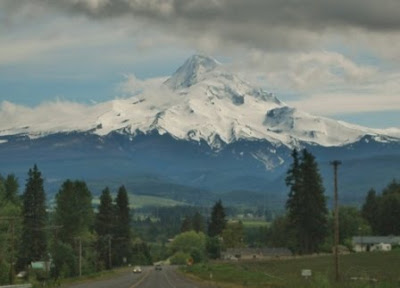
Post Multnomah falls (which is along I-84 exit 47), the infinty loop continues along I-84 until exit 64. Taking exit 64 and following along Oregon 35 (and then US 26) takes us to Mount Hood. After taking exit 64, the views of Hood along Oregon 35 and US 26 are simply breath taking. These routes are lush with dense forests and driving here is an un-describable feeling. See it to believe it, simply should not be missed :)

Just within a mile of the intersection of Oregon 35 and US 26 goes a small road (on left) towards Trilium Lake. Again, do not miss this. Trilium lake lies almost at the base of mount hood. The view of Mount Hood from this lake is awesome. If you're lucky, you may see a reflection of the mountain in the lake. Below is a pic I took from the lake. Again, hasn't quite turned out of the world .... but you can get an idea.

Fyi, when I was doing this trip, we'd started from Multnomah falls at about 2:30 pm and when I'd glanced my watch at Trilium, it was 4:30 already (we'd stopped for coffee in between for about half an hour I guess).

Another good place to see is Mount Hood reflection in Mirror lake. This lake is just about a couple of miles from the Trilium Lake diversion at US 26 and should also not be missed.

Oregon 35 and US 26 are very well marked roads. Once on these roads you would see signboards for Lake Trillium as well as mirror lake.

From mirror lake drive up the mountain to Timberline Lodge. Timberline Lodge is as high as you can go up the mountain, as far as vehicles are concerned. Views of vistas from the mountain are serence and view of the mountain summit itself is quite beautiful.
Remember that you are going to spend a lot of time taking pictures along Oregon 35 and US 2, then along Trillium and Mirror lakes, and also at Timberline. Therefore even if you reach the mount hood area at about 4:30, you end up being at Timberline even post 7 pm or so.

That's it for the day as far as site-seeing is concerned. Now some big questions start to come: Where to have dinner ? Where to refuel the car ? Where to spend the night ?

Dinner options: Didn't I say pack some food when leaving Portland :) .... Kidding! Timberline Lodge has a very good restaurant of its own. I am not very sure until what time it is open but I believe it is until 9 pm in summer. We had a sumptuous dinner at Timberline at about 7, 7:30 pm during our trip. Remember though that Timberline is an expensive place. If you prefer keep things cost effective, it is always a good idea to dine in on the extra subs and stuff that you would hopefully have carried over from Portland.

Fuel: Going west, there is a gas station at US 26 right after the turn to head over to Timberline. I think gas at this place is expensive but there really aren't too many options :)

Lodging: During our trip, post dinner, we headed back along US-26 east and Oregon 35 to a bed and breakfast place called "Mt. Hood Hamlet Bed & Breakfast" where we stayed for the night. This B&B is about 45 minutes drive from Timberline Lodge (towards I-84 exit 64). When I was searching for accomodations online for this night, I wasn't able to find too many options so had to go with this B&B even though it was a tad expensive. But the B&B is very much worth its price: It is perfectly located with stunning views of Mount Hood and Mount Adams, the breakfast there tastes out of the world, and the owners are very courteous and helpful. Plus, the cosiness of this B&B is just what you may need after a tiring day of site seeing. During our trip, we had driven about 300 miles (starting from Seattle) on Day 1 and had stopped and photographed all of these places along the infinity loop. We were extremely exhausted and were in bed even before the clock had ticked past 10 pm :)

More information about infinity loop can be found in the pdf guide at http://www.mthoodcolumbiagorge.com/loopguide.pdf

Day 2 - Painted Hills

Plan to get ready and check out of the B&B at about 9:00 am. We'd asked Diane (our host at the B&B) to have our breakfast ready at 8:30. Enjoy your breakfast, it is just amazing at "Mt. Hood Hamlet Bed & Breakfast". It would make you feel that the hotel is really worth all the price paid :)

After breaking-fast, start driving towards Painted Hills which is about 150 miles from the B&B. The drive starts again along the same Oregon 35 towards Mt. Hood but then you need to take US 26 east (instead of west which goes towards Hood and Portland). Mt. Hood national forest appears to get even denser as we descend the mountain and after the descent, the drive seems to be going through a desert like terrain. Then suddenly, you get to see the 3 sisters on your right which appear almost as big as Mt. Hood.

Once you pass Madras and head west towards Painted Hills, there is a sudden dearth of restaurants and gas stations. Therefore, pack some sub's/sandwiches to take care of your lunch at Painted Hills.

Painted Hills appear simply magical because of the delicately colored stratifications in the soil. The yellows, golds, blacks, and reds of the Painted Hills are best seen in the late afternoon. Tones and hue may appear to change from one visit to another, as the claystones differwith ever-changing light and moisture levels. Good information about these structures can be found at Painted Hills Information.

If you'd left the B&B at Mt. Hood at 9'ish you would reach painted hills at about 1 pm. Take some time for rest and lunch, and at about 1:30 begin exploring the hills. As I said earlier, afternoon is the best time to see the hills. During my trip, I had not done much research about which trails to hike, what to see at the hills etc. For painted hills, such research is really not needed. You can just head to the painted hills parking lot and at the notice board plenty of information along with maps can be found.

Explore the hills between 1:30 to about 5:30. You'd spend time taking lots of pictures, the hills are really fabulous and feel completely out of the world. The striking feature about the hills is that they are so very different from the landscapes that we come across often. And that is exactly the point I was making about Oregon: The diversity is just unbelievable. From the forests and snow caps along Inifinity Loop to the fossilized painted hills within a matter of 3 hours is an unbelievable transition. I highly recommend exploring the Painted Hills when in Oregon.

As the light starts to fade a little bit, begin your drive ..... drive to Crater Lake. Ideally, one should wait at Painted Hills until sunset. But painted hills to any lodge near crater lake is atleast a 4 hour drive and therefore, its advisable to start your drive well before sunset.

Most lodges very close to Crater Lake are expensive. I had therefore booked a motel in Chemult, which is about 40 miles north east of crater lake. We'd started from Painted Hills at about 5:30, stopped on our way to Chemult in between for a coffee break near Madras, and reached the motel at about 9:30 pm.

The lodge in Chemult (Chemult Motel) is not exactly great but good enough to spend a night. And that is what is required: An inexpensive place, close to Crater Lake, to just have a good night's sleep. Also, there is a subway, and another good cafe opposite the lodge which would save your day as far as dinner is concerned. During our trip, post dinner, off we'd gone to sleep at about 10:30 pm, it had been another hectic but well spent day ..... 350 more miles had been driven.

Day 3 - Crater Lake

The next morning, plan to check out from Chemult motel at about 8. As I said, there are a couple of restaurants in Chemult which which should take care of your breakfast. There is also a gas station right next to the Chemult motel. Refuel and get ready to enjoy the ultra amazing crater lake. Its about a 45-minute drive from Chemult to Crater lake north entrance. Try to get to the lake by about 9, 9:15 in the morning. My personal opinion is that Crater lake is at is best between 9 am to about 12 pm.

When you first see Crater lake, the feeling you get simply can't be put in words. Its absolutely jaw-dropping. We were totally stunnned, left completely speechless, on getting the first view of the lake. Never ever had I seen, leave alone seeing, never ever had I thought that water can be sooo blue, deep blue. Who on earth can say water has no color! The huge, deep blue lake combined with the snow along the slopes of rim drive is a view that I would never forget. And its a view, that would make me visit Crater Lake several more times. Stunning, gorgeous, out of the world it was. I'm just out of adjectives. To top it all for us, it was a completely cloudless day with clear skies .... tailor made for a crater lake visit.


Once at Crater Lake, you don't really need a guide to explore it. The lake lies all in front of you, inviting you, enticing you to make loads of pictures. The lake is bordered, all along its circumference, by a road called the rim drive. I think the total rim drive length is about 30 miles. There are numerous points/overlooks for visitors to stop by, make pictures and appreciate the magnificence of the unbelievably stunning crater lake.


Below is the map of the crater lake rim drive.


A few important tips when visiting crater lake:

1. When driving from Chemult, you would enter the park from the north entrance and thus the first point that you end up being at is the North junction (pointed in the map). Make sure that you drive the rim in clock wise direction. That way, all view points are easily accessible, and I think you reach at every spot at the perfect time of the day

2. I said at the start of this blog, July is the best time to visit Crater Lake. Crater Lake would only be half as beautiful without the snow along its rim. In an intense summer, almost all of the snow may melt away by mid August. Also, in my experience, 9 am-12 pm was the best time to visit the lake. For some reason, the water did not appear as blue to me post noon as much as it had appeared to me in the morning.

3. Every lookout point along the rim drive is very beautiful. But if I have to pick a few points that should just not be missed, then they are the Wizard Island from Watchman overlook, Pumice and Palisade points, and the Phantom ship overlook. Then again, you get some amazing views of Wizard island from another angle from the rim village visitor center.

4. You may be forgiven for forgetting to get food when coming here, you may be forgiven for forgetting to bring water when coming here. Thats fine. But there is one thing that you should just not forget: A mosquito repelant. Just like I had not seen water as blue as that of crater lake ever before, I had not seen mosquito's of such big size and such big in number for a long long time. They'd make your trip miserable if you don't have a repellant. Just no excuses for forgetting it.

5. Wear blue colored clothes when visiting Crater Lake. Trust me, your photos at the late would come really good with those :)

6. With reasonable number of stops, it takes about 4-5 hours to do the complete rim drive. Thus, if you started at about 9:30 am, you should be done with one round of the drive by about 1 pm. Thats a perfect time to have lunch beside the lake at the cafeteria at Rim village visitor center. I quite enjoyed the sandwich here, maybe because it was very tasty or maybe because I was very hungry.

The waters of the lake are just too beautiful and one just doesn't feel like leaving this place. One just feels like taking more and more pics of the magnificent lake (if you're someone as addicted to a camera as I am).

But about 2 pm is a good time to leave for Portland. I've heard that sunset is also quite beautiful at the lake but I never got a chance to experience it myself. Then again, Crater Lake to Portand is about 4 hours drive and therefore, because of the limitation of just a 3-day trip spending time at the lake post early afternoon is a luxury people like me cannot afford.

During my trip, we left Crater Lake at about 2 pm, reached Portland at about 6 and I was in bed at my home sweet home in Seattle at about 10 pm. For guys wanting to fly out of Portand, there are quite a few late night flying options out of PDX.

More details and a more complete information about Crater Lake National Park can be found at http://www.crater.lake.national-park.com/